
This course is focused on client side validation.
But before I move on, I want to reiterate that front-side validation is not enough. You also need to validate form data on the server (for example, with Node.js or PHP).
But why is client-side validation not enough?
3 reasons.
Suppose you are breeding warthogs. A user enters the number of warthogs he/she wants to purchase.
However, lets say you only have 2 warthogs left. In this case, you would want to display an error message to the user, like this:

The code for this will be something like:
if number_ordered > current_piglets then …
As you know, we get the number_ordered from the form the user filled out (on client-side).
But where does current_piglets come from?
Well, that comes from a look-up in a database. This is typical:
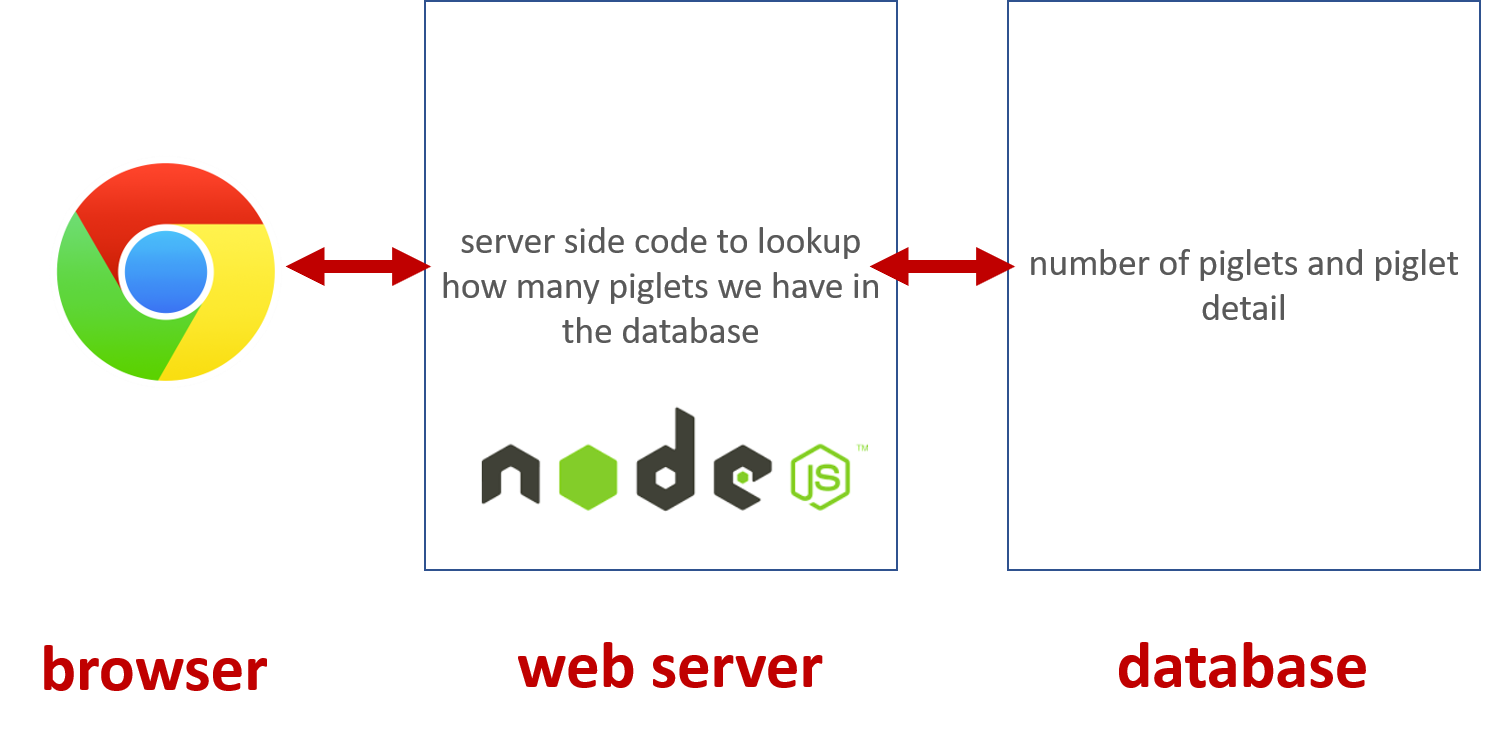
The server has access to the database. The browser does not.
Remember, every page a user sees in his or her browser is downloaded to his or her computer.
This includes the JavaScript that has the front-end validation code.
A clever hacker might be able to create a new version of your page, without the JavaScript checking. H/she could then fool your server into accepting invalid data.
You might make a mistake coding the JavaScript. For example, you might write:
if ( username = "" ) { //WRONG!
    tell the user he needs to write a username
}
else {
    accept the data
}
The first line is wrong. It should be:
if ( username == "" ) { … }
An easy thing to miss, but it could mean that you get bad data in your databases. This can mess up sales, event registration, or whatever business your app supports.
Having a server side check doubles up as a safety net, to catch any front-size coding errors you may have written.
Even though you can do client-side validation by writing JavaScript that runs on a browser, you also need to ensure checks are done on a server, because:
there are some checks you can only do on the server
it improves security
it helps you fix and identify front-end coding mistakes
ANYWAYS, let's get back into the topic at hand, and that is talking about the different types of client-side validation.
Keep motivated, and see you now :)